Is it "Olympic" or "Olympics"? A guide to sport and grammar
Celebrate the upcoming Olympic Games with this sports-themed guide to grammar.


- "Olympic" is an adjective (e.g., "Olympic torch," "Olympic athlete").
- "Olympics" is a plural noun and takes plural verbs like "are" and "were".
- Both "Olympic" and "Olympics" are always capitalized, along with "the Games."
Everyone knows about the Olympic Games, but not everyone knows how to write about them correctly. As an AI writing assistant run by Olympic hurdler Nick Hough, the Outwrite team felt uniquely placed to write about this topic.
With Paris 2024 still fresh in our memory and the countdown to LA 2028 already underway, here's a collection of FAQs covering common sporting terms and how to use them correctly.

Is it "the Olympics is" or "the Olympics are"?
This appears to be a contentious topic on the Internet. It concerns whether "Olympics" is a singular or plural noun.
Some have argued the Olympics can refer to a single event. In these cases, using a singular verb could be considered acceptable. For example:
The first Winter Olympics was held in 1924.
However, most dictionaries record "the Olympic Games" (and the shortened version, "the Olympics") as plural nouns. That means they should be used with "are" and "were". For example:
The Summer Olympics are held every four years.
What about "Olympic" or "Olympics"?
Olympic is an adjective. It may accompany nouns like "torch", "athlete" or "opening ceremony". Usually, only the word "Olympic" needs a capital letter (but more on that later).
Olympics (with an "s") is a noun. Use it when you're talking about the Olympic Games. The same rule applies to Paralympic (adjective) and Paralympics (noun).
Does "Olympic" always need a capital letter?
Yes. "Olympic Games", "Olympics", and "Paralympics" should always be capitalized. According to the Associated Press Stylebook, this rule also applies to "the Games". However, you don't need to capitalize the "the" in front of these words unless it's placed at the beginning of a sentence.
Other proper nouns should also have a capital letter. This includes athlete names, countries, and cities.
You don't need to capitalize common nouns unless they're the first word of a sentence or used as a title. For example, "coach" should be capitalized if it comes directly before a person's name.
| Type | Examples |
|---|---|
| Full capitalization | Olympic Games, 2020 Tokyo Games, Olympian |
| Partial capitalization | Olympic torch, Olympic gold medal, Olympic flag |
| Lowercase | athlete, referee, cycling, powerlifting |
Does someone go, do, or play a sport?

It depends on the type of activity you're referring to. Generally, the verb "play" accompanies sports that involve a ball.
I play....tennis, netball, baseball
Sports that end in "-ing" usually go with the verb "go".
I go....swimming, snowboarding, kayaking
There are some outliers, like gymnastics, which go with the verb "do".
I do...gymnastics, karate, archery
If you're unsure which verb to use, check Google!
Is it "record-breaking" or "record breaking"?
You'll probably hear reports of "record-breaking" performances over the next few weeks. This is an example of a compound adjective. It's formed when two or more words connect to modify a noun. Here are some examples:
- 12-month delay, middle-distance runner, full-time athlete
Generally, if a compound adjective comes before the noun (also known as the attributive position), it should be hyphenated. If it comes after the noun, or if it contains an adverb ending in -ly, don't hyphenate it.
Erriyon Knighton won the 200m sprint with a record-breaking time of 19.88 seconds.
Is it a "podium finish" or a "podium place"?
Both terms are correct, but they're used slightly differently. In sports journalism, these terms are nearly interchangeable, but there's a subtle distinction worth knowing if you're writing about athletics, cycling, Formula 1, or any other sport where finishing in the top three matters.
"Podium finish" emphasizes the result of the race or competition:
She secured a podium finish in the 100m hurdles final.
"Podium place" tends to refer to the position itself, often used when discussing standings or rankings:
Three athletes from the same country took all three podium places.
Is "Paralympics" grammatically treated the same way as "Olympics"?
Yes. "Paralympic" is the adjective form and "Paralympics" is the plural noun form, following the exact same capitalization and verb agreement rules as "Olympic" and "Olympics."
Should "gold medalist" or "Olympic gold medalist" be capitalized?
Only "Olympic" needs a capital letter in this phrase, since it's a proper adjective. "Gold medalist" remains lowercase unless it starts a sentence or precedes a name as a title.
Go for gold with Outwrite
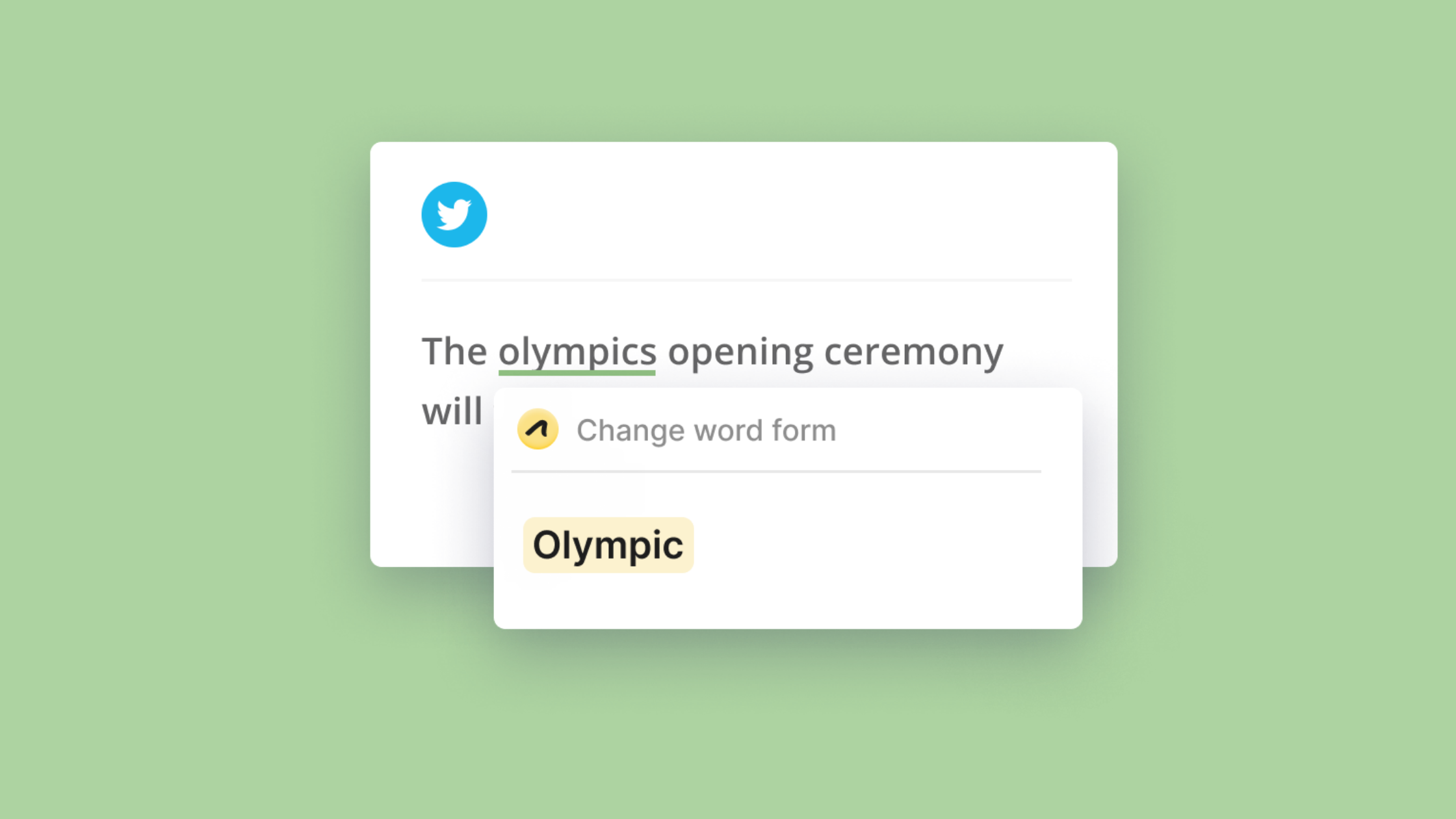
Hopefully these tips have set you up for success! If you need help fine-tuning your writing, check out Outwrite's free advanced grammar checker. Apart from fixing spelling and punctuation mistakes, it'll make sure you use the correct form of "Olympics" every time.